UHF RFID for Warehouses, Dock Doors & Portals
Plan RFID for warehouse management: fixed readers and circular antennas at dock doors, conveyor tunnels, handheld cycle counts and on-metal asset tags.
Send us your controller model, card type and install environment. We'll shortlist compatible hardware and quote within 24 hours.
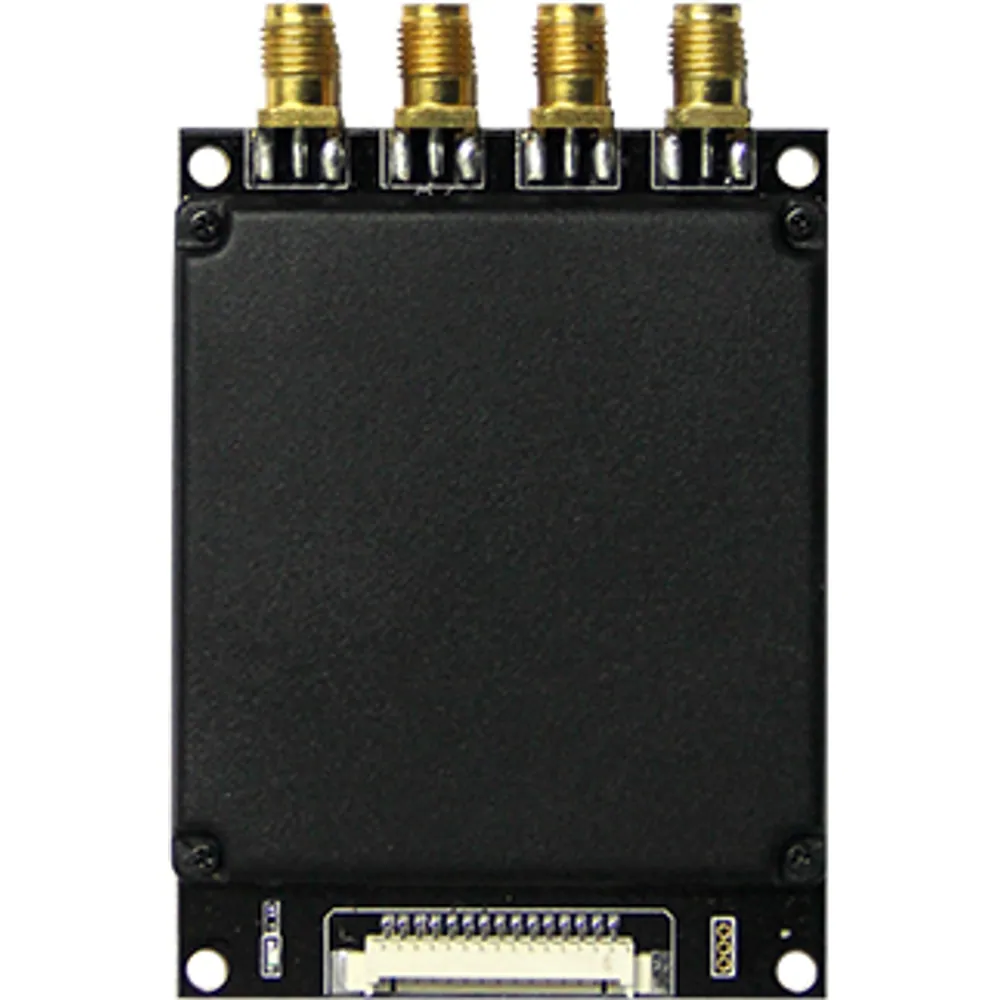
Four-antenna UHF reader engine on the Impinj R2000 for smart cabinets, shelf readers and portals: 0–33 dBm, 700+ tags/s, TTL UART, FCC and ETSI versions.
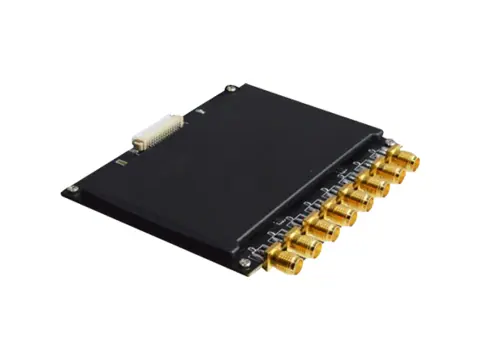
The GM-120 is a 4-port UHF RFID reader module that drives four antennas from one embedded board. OEMs pick this format for smart cabinets and lockers, shelf and drawer readers, and two-sided portals, where a single antenna would leave blind spots and four separate readers would add cost and cabling. It is built on the Impinj R2000 chipset and connects to your host through a TTL UART.
Cabinets and portals often stand close to other readers, so the dense-reader mode is worth noting; a single-reader mode is also available. Transmit power is adjustable up to 33 dBm, sensitivity is better than −85 dBm, and the inventory rate peaks above 700 tags per second into a 1,000-tag buffer. Each read can carry an RSSI value for your software to work with, while antenna-connection protection and temperature monitoring run on board. Both EPC Gen2 / ISO 18000-6C and full ISO 18000-6B read/write are supported.
For North America and other FCC markets, order GM-120-4P-US (902–928 MHz). For Europe, GM-120-4P-EU follows ETSI EN 302 208 at 865–868 MHz, with or without listen-before-talk.
The board measures 67.5 × 51 × 8.2 mm and needs an external heatsink for air cooling. Plan for 3.7–5 V DC at 1.2 A (±10%). The 15-pin header uses the same signal assignment as the single-port GM-130 and the 8-port GM-110: TTL UART at 115200 bps (38400 bps alternative), two inputs and two outputs at 3.3 V, a buzzer output above 50 mA, an active-high enable and an RS485 direction-control pin, with the USB lines reserved for factory test. Host firmware and wiring therefore carry over between port counts; only the board outline changes. An SDK is available.
| Reader chipset | Impinj R2000, dual-CPU design |
|---|---|
| Frequency range | 860–960 MHz |
| Order versions | US: FCC 902–928 MHz; EU: ETSI EN 302 208 865–868 MHz (with or without LBT) |
| Other region plans listed | China, Japan, Korea, Malaysia, Taiwan |
| Air protocols | EPCglobal UHF Class 1 Gen 2 / ISO 18000-6C; ISO 18000-6B (full read/write) |
| Output power | 0–33 dBm, adjustable |
| Receiver sensitivity | < −85 dBm |
| Antenna ports | 4 |
| Read range | 5 cm – 20 m, depending on antenna and tag |
|---|---|
| Peak inventory speed | > 700 tags/s |
| Tag buffer | 1,000 tags @ 96-bit EPC |
| Work modes | Single-reader / dense-reader |
| Built-in diagnostics | Tag RSSI, antenna-connection protection, ambient temperature monitoring |
| Host interface | UART, TTL level (15-pin header) |
|---|---|
| Baud rate | 115200 bps (default), 38400 bps |
| GPIO | 2 inputs + 2 outputs, 3.3 V level |
| Buzzer output | Driven, > 50 mA |
| RS485 | Direction-control pin for an external transceiver |
| USB pins | Factory test only |
| Development | SDK available |
| Supply voltage | 3.7–5 V DC |
|---|---|
| Operating current | 1.2 A ±10% |
| Dimensions | 67.5 × 51 × 8.2 mm |
|---|---|
| Cooling | External heatsink, air-cooled |
| Operating temperature | −15 to +55 °C |
| Storage temperature | −20 to +70 °C |
| Relative humidity | 15–90% |
| Pin | Signal | Function |
|---|---|---|
| 1 | GND | Ground (connect both GND pins) |
| 2 | GND | Ground |
| 3 | VCC 3.7–5 V DC | Supply input (connect both supply pins) |
| 4 | VCC 3.7–5 V DC | Supply input |
| 5 | GPIO 3 | Output (3.3 V level) |
| 6 | GPIO 4 | Output (3.3 V level) |
| 7 | GPIO 1 | Input (3.3 V level) |
| 8 | BUZZER | Driven buzzer output, > 50 mA |
| 9 | UART_RXD | Serial data in, TTL level |
| 10 | UART_TXD | Serial data out, TTL level |
| 11 | USB_DM | USB D−, factory test only |
| 12 | USB_DP | USB D+, factory test only |
| 13 | GPIO 2 | Input (3.3 V level) |
| 14 | EN | Module enable, active high |
| 15 | GPIO 5 | Direction control for an external RS485 transceiver |
Same header on the 1-, 4- and 8-port versions. Tie both GND pins to ground and both supply pins to the 3.7–5 V rail.
| SKU | Antenna ports | Band / regulation | Host interface |
|---|---|---|---|
| GM-120-4P-US | 4 | FCC, 902–928 MHz | TTL UART |
| GM-120-4P-EU | 4 | ETSI EN 302 208, 865–868 MHz | TTL UART |
Specifications can change between production batches. Confirm the current revision with us before placing volume orders.
Quote the SKU that matches your frequency, interface and mounting. Not sure? Send us your controller model and we will pick the variant for you.
| SKU | Configuration | Actions |
|---|---|---|
| GM-120-4P-US | 4-port module, US FCC band (902–928 MHz), TTL UART | |
| GM-120-4P-EU | 4-port module, EU ETSI band (865–868 MHz), TTL UART |
Plan RFID for warehouse management: fixed readers and circular antennas at dock doors, conveyor tunnels, handheld cycle counts and on-metal asset tags.
Build an RFID asset tracking system: on-metal, ceramic and tie-on tags matched to each asset, handheld audits, smart cabinets and IP67 HF heads for tooling.
RFID linen tracking hardware: washable UHF laundry tags, fixed tunnel readers, antennas and handhelds for hotels, hospitals and laundries. Samples available.
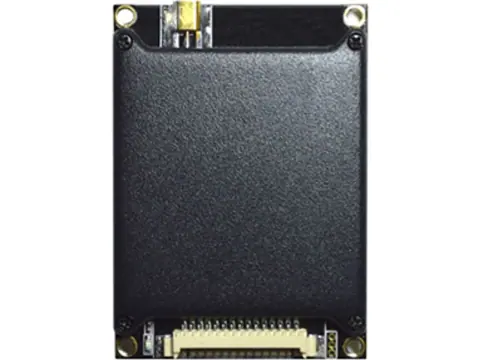
The signal assignment of the 15-pin header is the same on GM-130, GM-120 and GM-110, so host firmware and wiring carry over. The board outlines differ (55.5 × 39.5, 67.5 × 51 and 69.5 × 91 mm), so plan mounting and heatsinking per model.
It needs an external heatsink and is cooled by air through that heatsink. No fan is specified in the module data.
The module offers a dense-reader mode in addition to single-reader mode, intended for sites where several readers operate close together.
GM-120-4P-US operates in the FCC 902–928 MHz band; GM-120-4P-EU operates under ETSI EN 302 208 at 865–868 MHz. Port count, size and pinout are identical.
Yes, an SDK is available. Request it with your sample so your firmware team can evaluate the command set before volume orders.
Compare UHF RFID reader bands by country, including US, EU, UK, China, India and Japan. Understand ERP, EIRP, channel conditions and radio approvals.
Wire a UHF reader's D0, D1 and ground to your controller, match 26/34-bit Wiegand, size 12 V power and trigger the barrier by relay. Diagrams included.
Yes, RFID works on metal with tags built for it. See why metal detunes standard tags, compare ABS, PCB, ceramic and label tags, and test read range properly.
Embeddable single-antenna UHF reader engine on the Impinj R2000: 0–33 dBm output, more than 700 tags/s and a 15-pin TTL UART header, in FCC and ETSI versions.
Eight-antenna UHF reader engine on the Impinj R2000 for multi-shelf cabinets and tunnel readers: 0–33 dBm, 700+ tags/s, 1,000-tag buffer, TTL UART.
One UHF reader module for both 865–868 MHz and 902–928 MHz builds: 7–30 dBm output (±1 dB), sensitivity below −85 dBm, hardware watchdog and TTL UART.
50 × 50 mm integrated UHF RFID module for handhelds and desktop card issuers: 18–26 dBm, 100–250 mA, TTL UART, reads up to 3 m with no heatsink. US and EU versions.
Stamp-sized 23 × 20 mm UHF RFID reader module for US-band (902–928 MHz) devices: 18–26 dBm, sensitivity below −85 dBm, TTL UART and a hardware watchdog.
IP66 integrated UHF reader that identifies vehicle tags at up to 12 m (9 dBi) or 30 m (12 dBi), with Wiegand 26/34, RS485, USB and optional TCP/IP.
IP66 all-in-one UHF reader and access controller: stores 5,000 users, controls the gate lock, opens by Bluetooth and reads tags at up to 10 m or 20 m.
445 mm IP66 integrated UHF reader with a 12 dBi linear antenna that reads vehicle tags at 10–20 m and reports over Wiegand, RS485 or optional TCP/IP.
Send your card type, interface and quantity. You get a quote, lead time and compatibility notes within 24 hours — samples available for most items.