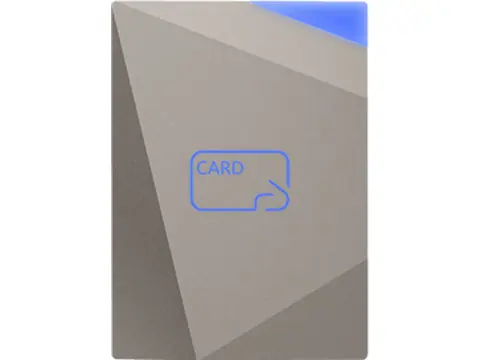
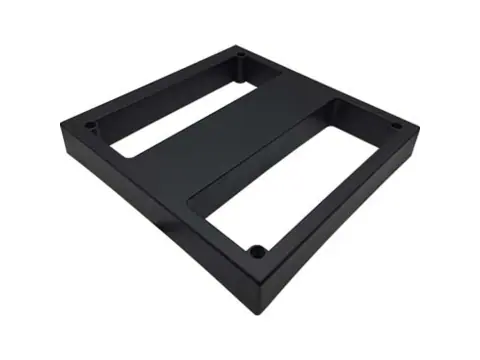
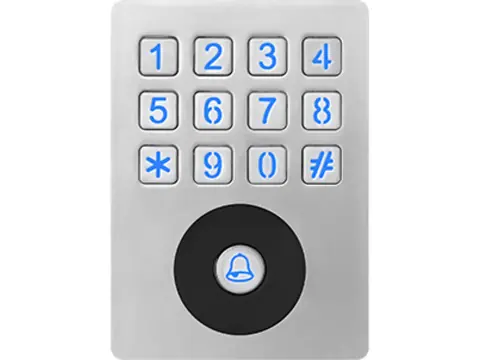
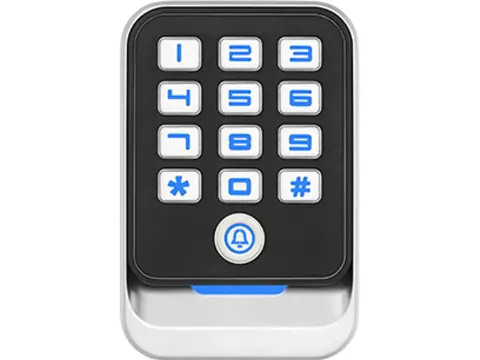
An RFID vehicle access control system identifies each vehicle by a passive UHF tag on its windshield, checks the tag against a list of authorized vehicles and signals the barrier to open, so drivers never stop to present a card. A typical lane needs one long-range UHF reader, an access controller or parking software, and a dry-contact connection to the barrier’s open input. We supply the identification and control hardware for car parks, corporate campuses, logistics yards and residential compounds; the boom barrier or gate operator comes from your barrier supplier.
Why proximity cards struggle at vehicle lanes
125 kHz and 13.56 MHz card readers couple through the magnetic near field, so their read range is measured in centimeters. At a barrier, that means drivers leaning out of the window in rain and darkness while the queue grows, and cards passed from car to car.
A passive EPC Gen2 tag (ISO/IEC 18000-63) has no battery; it answers by backscattering part of the reader’s signal and can be read at several meters. That range also causes most lane problems:
- Adjacent lanes and queues. A reader that sees too far opens the barrier for the wrong car.
- Coated windshields. Metallic heat-reflective layers can block UHF almost completely.
- Regional radio rules. The reader must match the country’s UHF band.
- Data width. Wiegand 26 carries 24 ID bits and Wiegand 34 carries 32, while an EPC is commonly 96 bits.
How a typical RFID parking lane is laid out
Every lane follows the same chain: vehicle tag → long-range UHF reader → access controller → barrier relay.
- Vehicle tag or UHF card. A windshield tag stays with the vehicle; a UHF card suits drivers who switch vehicles. Tamper-evident tags that break when peeled off stop a tag moving to another car.
- Long-range UHF reader. An integrated reader combines the radio and a directional antenna in one weatherproof housing and turns the tag’s EPC or TID into a number.
- Access controller or parking software. It decides whether that number is allowed right now (whitelist, schedule, anti-passback) and logs the event.
- Barrier. The controller’s relay closes a dry contact across the barrier’s open input. The barrier keeps its own loop detector or photo-eye, which protects vehicles and people independently of the RFID system.
At the enrollment desk, a USB desktop UHF reader/writer registers or encodes tags before they are handed out, so nobody drives through a lane to enroll a vehicle.
Small sites can skip the controller: some integrated readers hold their own whitelist and switch a relay, so a single residential gate can run on the reader alone. You lose central logs, schedules and anti-passback, so use controller mode for entry/exit pairs or several lanes.
Hardware selection by lane and zone
| Location |
Recommended hardware type |
Key spec to check |
| Car entry or exit lane |
Integrated long-range UHF reader + windshield tags |
Regional band variant; adjustable RF power; Wiegand 26/34 byte selection; IP rating |
| Truck gate or logistics yard |
Long-range reader positioned for high cabs, or a fixed reader with outdoor circular-polarized antennas |
Tag heights across the fleet; antenna gain within regional power limits; cable loss |
| Single residential or private gate |
Integrated UHF reader with built-in relay and whitelist |
User capacity; relay contact type; how tags are added and removed |
| Pedestrian side gate |
Mid-range UHF reader with UHF cards, or a 13.56 MHz card or keypad reader |
Short, controlled read zone that ignores passing vehicles |
| Vehicles with coated windshields |
On-metal UHF tag for the license plate area or body |
Mounting surface; weather exposure; tamper evidence |
| Security office / enrollment desk |
USB desktop UHF reader/writer |
Same band as the lanes; keyboard-emulation output or SDK; EPC write and lock support |
| Gatehouse or cabinet |
Networked door controller + 12 V DC power supply in an enclosure |
Free Wiegand inputs; 34-bit support; one relay per lane; anti-passback |
Start with our long-range UHF readers for the lanes and ceramic vehicle tags for windshield or metal mounting.
Lane planning: mounting, read zone and anti-passback
- Aim at the stop point. Position and tilt the reader so the tag sits well inside the read zone where the vehicle slows for the arm, not at the edge of range.
- Match tag height. Mount the reader roughly level with the windshield tags it must read. Mixed car and truck traffic may need testing at both heights, or a second reader.
- Treat rated range as a ceiling. Datasheet ranges assume a specific tag in open space; glass, tag angle and the vehicle body shorten them.
- Turn power down, not up. Use the lowest RF power that reads reliably, so the reader ignores the next lane and the second car in the queue. Where a reader has a trigger input, a loop detector can limit reading to when a vehicle is present.
- Stay within radio limits. FCC Part 15 permits up to 1 W conducted power in 902–928 MHz with antenna gain up to 6 dBi (4 W EIRP). ETSI EN 302 208 allows up to 2 W ERP on four high-power channels in 865–868 MHz. A higher-gain antenna does not buy legal range, because conducted power must come down to stay within the limit. For other countries, see UHF RFID frequency by country.
- Pair entry and exit. Give each direction its own reader and controller channel, and don’t point the two readers at each other. Anti-passback then refuses a second entry until the tag has been read on exit, so one tag cannot admit two vehicles.
- Filter repeats. Set the reader’s same-tag interval so a waiting car does not generate a stream of events.
Integration and installation notes
Wiegand output. A Wiegand 26 or 34 frame is shorter than an EPC, so the reader sends only some bytes, commonly the last three in 26-bit mode and the last four in 34-bit mode. Encode tags with serialized EPCs or output TID bytes, prefer 34-bit when the controller supports it, and confirm byte selection before enrolling the fleet. Our UHF reader Wiegand wiring guide covers bit layout, wire colors and troubleshooting.
RS485 or TCP/IP. Parking software that needs the full EPC or remote reader settings needs a two-way link. Ask for the reader’s protocol document or SDK before building software around it.
Power and cable. Long-range readers draw far more current while transmitting than proximity readers. Power them from a dedicated 12 V DC supply near the lane, tie reader ground to controller ground, and keep data cable away from the barrier motor’s mains wiring.
Tag security. A standard EPC can be copied onto another tag; locking the EPC bank stops rewriting, not copying. Outputting the TID (fixed when the chip is made) and using tamper-evident tags raise the bar. Where spoofing is a real risk, specify tags with cryptographic authentication and a reader and software that verify it.
Typical bill of materials
Per lane (each direction)
Per site
Per vehicle
Not supplied: barriers and gate operators, loop detectors, poles and lane islands. Your barrier supplier provides these; our hardware triggers the barrier’s open input.
Why source the lane kit from one supplier
- One band across the order. Lane readers and the desktop issuer ship in the same regional band, with tags chosen to perform in it.
- Format checked before dispatch. Send your controller model and Wiegand format; we confirm the reader’s output and byte selection and test before shipping.
- Samples for a lane test. Try a reader and a few tags on your own vehicles and glass before ordering in volume.
- Mixed orders. Readers, tags, controllers and power supplies in one quote and one shipment.
- Encoding on request. Ask about EPC encoding and printed numbering, so each tag’s printed number matches what the controller receives.
Next steps
Tell us the installation country, entry and exit lane count, vehicle types, how many vehicles need tags, your controller model and Wiegand format, and whether parking software needs RS485 or TCP/IP. We’ll propose a lane-by-lane bill of materials and can send samples for testing. Request a quote and we’ll reply within 24 hours.