UHF RFID livestock tags let a farm, feedlot or saleyard identify animals as they walk through a race, gateway or weighing crate, reading at meters instead of the short range of 134.2 kHz readers. A typical setup pairs UHF ear tags with a fixed reader and outdoor antennas at each handling point, plus a handheld for pen work, all feeding herd-management software. UHF adds hands-free management reads; it does not replace the ISO 11784/11785 tags that official animal ID schemes require in many countries.
UHF alongside official 134.2 kHz animal ID
Official electronic animal ID in many countries uses 134.2 kHz low-frequency transponders coded to ISO 11784 and read to ISO 11785, in FDX-B or HDX form. Examples include the EU rules for sheep and goats and Australia’s NLIS for cattle. Each official tag carries a 15-digit number (a 3-digit country code plus a 12-digit national ID) registered to the animal. Rules differ by country and species, and only devices on the scheme’s approved list count as official ID.
UHF ear tags do a different job: group and walk-through reads for weighing, drafting, feeding records and dispatch counts. They use passive EPC Gen2 chips (ISO/IEC 18000-63), which include anti-collision so a reader can inventory many tags in the same field. One approach is an official LF tag in one ear and a UHF management tag in the other, linked in software; first confirm that your scheme allows an extra ear tag. See LF vs HF vs UHF RFID for how the bands differ.
Why reading animals is harder than reading pallets
- Bodies absorb UHF. Water-rich tissue soaks up UHF energy. A tag on the far side of the head from the antenna, or buried in a bunched group, may not answer.
- Tags never sit still. Ears flap, heads turn and animals crowd at gates, so tag orientation keeps changing.
- Steel everywhere. Race panels, crushes and gates reflect UHF, creating dead spots and stray reads from the next pen.
- Small tag antennas. A 30 mm button ear tag has far less antenna than a windshield or pallet label, so its range is shorter, especially from a handheld.
- Harsh surroundings. Mud, manure, washdown water, barn ammonia and rubbing animals all attack antennas, connectors and cables.
How a UHF livestock system is laid out
Every handling point follows the same chain: ear tag → antenna → reader → herd software.
- UHF ear tag. A nylon and TPU button tag with a passive EPC Gen2 chip. Our livestock ear tags come in closed-hole and through-hole 30 mm versions.
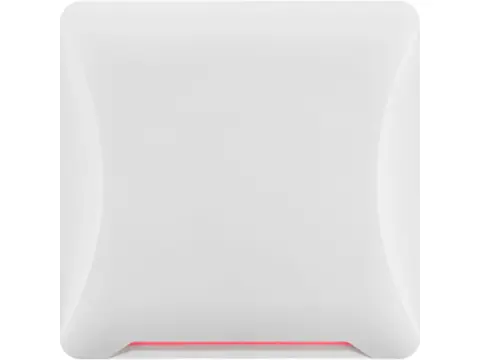
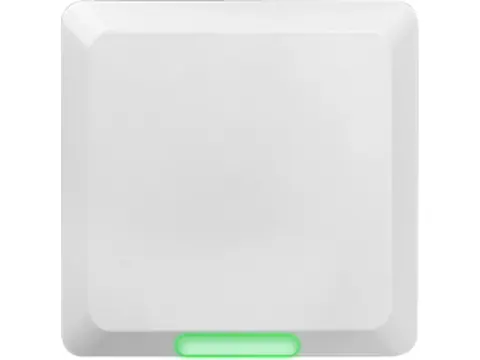
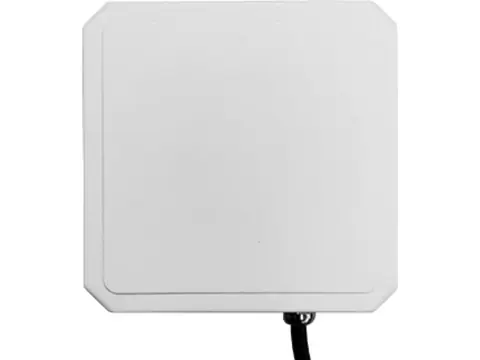
- Antennas. Weatherproof circular-polarized panels mounted beside or above the race, gateway or crate. Circular polarization reads tags at any rotation, which matters when ears move.
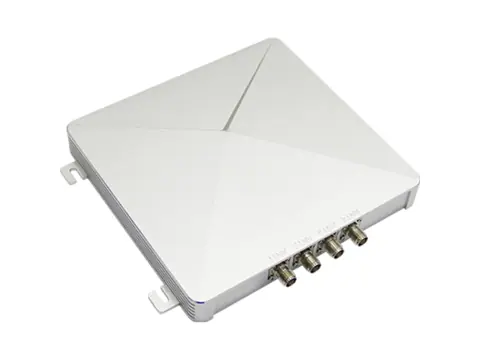
- Reader. A fixed multi-port UHF reader drives four or eight antennas, so one reader can cover a race and a nearby crate if cable runs stay short. The antenna port shows where each read happened.
- Software. Your herd-management or custom software receives the tag number over RS232 or TCP/IP and joins it to the weight, location, treatment or dispatch record.
A tagging station completes the system. A USB desktop reader/writer registers each UHF tag, or writes your numbering into it, before or at application.
Hardware selection by handling point
| Location |
Recommended hardware type |
Key spec to check |
| Single-file race or alley |
Fixed multi-port reader with antennas facing each other across the race at ear height |
Adjustable RF power; IP67 antennas; GPIO input for a beam sensor |
| Gateway between paddocks or pens |
Fixed reader with circular-polarized antennas on gate posts or overhead |
Beam width against gateway width; cable length and loss; mounting out of animals’ reach |
| Weighing crate or scale |
Fixed reader port with a compact antenna aimed into the crate only |
Contained read zone; RS232 or TCP/IP link to the software that records weights |
| Loading ramp or dispatch |
Fixed reader and antennas at the ramp, or a handheld |
One confirmed read per animal; dispatch count logged against the load |
| Pens, barns and paddock checks |
Android UHF handheld |
Handheld range on small ear tags; IP rating; battery for a full round; app or SDK |
| Tagging station or office |
USB desktop UHF reader/writer |
Same band as the site; EPC write and lock support; keyboard-emulation output or SDK |
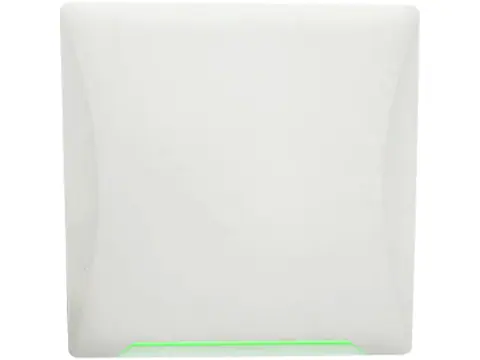
For antennas, our UHF antenna range includes an IP67 9 dBi circular-polarized outdoor panel for wider gateways and a compact IP67 6 dBi model for crates and tight races. Handhelds read small ear tags at close range, so a pen count means walking the pen.
Installation checklist
- Mount at ear height for the species. Pigs, sheep and cattle carry their tags at very different heights. Adjustable brackets help on shared races.
- Read one animal at a time where records matter. Weights and treatments belong in a single-file race or crate. Group reads at a gateway suit counts; compare them with the expected number.
- Contain the read zone. Set the lowest RF power that reads reliably and aim antennas along the race, not into neighboring pens. Then confirm that animals in the next pen are not read.
- Guard antennas with plastic, not metal. Polycarbonate or timber guards pass UHF; steel mesh blocks it.
- Keep coax short and sealed. Every meter of cable costs signal; use low-loss cable and weatherproof outdoor connectors.
- Stay within radio limits. FCC rules allow 1 W conducted power in 902–928 MHz with antenna gain up to 6 dBi (4 W EIRP), so a 9 dBi antenna needs reduced power. ETSI EN 302 208 allows up to 2 W ERP in 865–868 MHz. See UHF RFID frequency by country for other bands.
- Trigger and filter. A beam sensor on the reader’s GPIO input can open a read window per animal. Filter repeat reads in software so a waiting animal is recorded once.
- Confirm the applicator. Ear tags must go in with the applicator designed for that tag, so check which one fits before a herd-wide rollout.
- Separate nearby readers. Where two readers share a shed, enable dense reader mode or interleave their read windows so they don’t interfere.
Each UHF chip has a factory-programmed TID, a unique serial on most chips, and a writable EPC, commonly 96 bits. Two common approaches:
- Write your own number. Use the desktop writer to put a herd number, or the animal’s official 15-digit number, into the EPC, then lock the EPC bank with an access password so it cannot be rewritten in the field.
- Pair at tagging. Keep the factory number and, at tagging, read the official LF tag with your scheme reader and the UHF tag with a handheld, then save the pair in herd software.
Either way, a lost UHF tag can be replaced and re-linked without touching the official record.
Typical bill of materials
Per handling point (race, gateway or crate)
- Fixed 4- or 8-port UHF reader in the regional band (one reader can serve nearby points)
- Two or more circular-polarized IP67 antennas, sized to the read zone
- Low-loss coaxial cables with connectors matched to the reader and antennas
- Weatherproof enclosure, DC power supply and surge protection
- Optional beam sensor wired to the reader’s GPIO input
Per site
Per animal
- UHF ear tag, closed-hole or through-hole, plus spares for losses
Not supplied: official 134.2 kHz tags and their readers, scales, drafting gates and herd-management software.
Why source the UHF layer from one supplier
- One band across the order. Tags, fixed readers, handhelds and the desktop writer are specified for the same regional band.
- Samples for a race test. Try ear tags, a reader and antennas on your own animals and races before ordering in volume.
- Compatibility checked before dispatch. We confirm antenna connectors, cable lengths and the reader interface, and we test before shipping.
- Mixed orders. Tags, readers, antennas, cables and handhelds arrive in one quote and one shipment.
- Encoding on request. Ask about EPC pre-encoding so tags arrive in your numbering scheme.
Next steps
Tell us the country of installation, the species, how many animals need tags, which handling points you want to read (race, gateway, crate, ramp), the distance from each point to power and network, and the software and interface you use. We’ll propose a bill of materials per handling point and can send samples for testing. Request a quote and we’ll reply within 24 hours.