Key takeaways
- LF (125–134.2 kHz) and HF (13.56 MHz) couple through a magnetic field and read at centimeters; UHF (860–960 MHz) uses backscatter and reads at meters.
- NFC is a subset of 13.56 MHz HF RFID. Phones cannot read 125 kHz LF tags or UHF tags.
- Doors use LF or HF for deliberate short-range presentation and, at HF, cryptographic card security; gates, vehicle lanes and warehouses use UHF for hands-free, multi-tag reads.
- UHF is regional: order FCC 902–928 MHz or ETSI 865–868 MHz hardware to match the country of installation.
- Water and metal affect UHF the most; LF is the most tolerant of water and tissue, which is why animal ID uses 134.2 kHz.
LF (125–134.2 kHz) and HF (13.56 MHz) RFID couple through a magnetic field and read at a few centimeters, which is why they are the norm for door cards, key fobs and animal ID. UHF (860–960 MHz) RFID reflects radio energy back from the tag, reads many tags at once from several meters away, and runs vehicle gates, dock doors and warehouses. NFC is not a fourth band: it is a family of 13.56 MHz HF standards shared by phones and NFC tags.
Frequency bands at a glance
Passive RFID tags have no battery. They harvest energy from the reader’s field and answer with an ID or data, and the frequency determines how that energy moves. At LF and HF the wavelength (about 2.4 km at 125 kHz and 22 m at 13.56 MHz) is far larger than the read distance, so the tag sits in the near field of the reader’s coil and the two coils behave like a loosely coupled transformer. At UHF the wavelength is 33–35 cm, the tag sits in the far field, and it replies by switching the impedance of its antenna to reflect part of the reader’s signal back, a technique called backscatter.
| Property | LF | HF | NFC | UHF (RAIN) |
|---|---|---|---|---|
| Frequency | 125 kHz; 134.2 kHz for animal ID | 13.56 MHz | 13.56 MHz | 860–960 MHz overall; FCC 902–928 MHz, ETSI 865–868 MHz |
| Wavelength | ~2.4 km at 125 kHz | ~22 m | ~22 m | ~33–35 cm |
| Coupling | Inductive (magnetic near field) | Inductive | Inductive | Radiative backscatter (far field) |
| Main standards | ISO 11784/11785 (animal ID), ISO/IEC 18000-2; EM4100-type card formats | ISO/IEC 14443 A/B, ISO/IEC 15693, ISO/IEC 18000-3 | ISO/IEC 18092; NFC Forum Type 1–5 tags | ISO/IEC 18000-63 (GS1 EPC Gen2) |
| Typical passive read range | A few cm to ~10 cm with card readers | Up to ~10 cm (14443); up to ~1 m with large antennas (15693) | A few cm | Several meters; 10 m or more with fixed readers in good conditions |
| Data rate | ~2–4 kbit/s | 106–848 kbit/s (14443); ~26 kbit/s (15693) | 106–424 kbit/s | Up to 640 kbit/s tag-to-reader |
| Multiple tags in the field | Usually one at a time | Yes, with anticollision | Normally one tag per tap | Hundreds per second in good conditions |
| Security options | Fixed ID, no cryptography | UID-only up to AES-128 (e.g., DESFire EV2/EV3) | Depends on the chip (e.g., NTAG 424 DNA uses AES-128) | 32-bit access and kill passwords; optional crypto in newer Gen2 versions |
Passive UHF RFID is also called RAIN RFID, the industry alliance’s name for tags and readers that use the GS1 EPC Gen2 protocol (ISO/IEC 18000-63). Gen2 tags hold separate memory banks for the EPC, the TID (a tag identifier programmed by the chip maker), optional user data and the reserved password area.
LF and 13.56 MHz hardware can be used worldwide without regional variants. UHF cannot: the United States uses 902–928 MHz under FCC Part 15 (Canada allocates the same band), Europe uses 865–868 MHz under ETSI EN 302 208, and other countries allocate their own slices of 860–960 MHz. A reader set up for one region’s band may not legally be used where a different band applies, so order the regional variant that matches the installation. Tags are usually specified across 860–960 MHz, although sensitivity can vary across that range. Our UHF RFID frequency by country guide lists regional allocations.
Read range, speed and behavior near metal and liquid
Range. Near-field magnetic coupling fades fast: the field from a small coil falls with roughly the cube of distance, so doubling the gap cuts field strength about eightfold. That is why LF and HF ranges depend mostly on antenna size, from a few centimeters for a wall reader to around a meter for large ISO/IEC 15693 antennas. A UHF tag harvests power from a propagating wave whose power density falls with the square of distance, so it reads at meters, limited by tag chip sensitivity and regional power limits.
Speed and multi-tag reads. Common 125 kHz chips simply repeat their ID and expect one tag in the field. HF protocols include anticollision, which lets a reader select one card from several (ISO/IEC 14443) or inventory a stack of labels (ISO/IEC 15693). EPC Gen2 was designed for bulk inventory: its slotted anticollision scheme, the Q algorithm, lets a reader count hundreds of tags per second in good conditions.
Water. LF passes through water and animal tissue with little loss, which is why pet microchips and livestock boluses use 134.2 kHz. HF handles water-rich items reasonably well. Water absorbs UHF energy, and tags on bottles or close to the body detune, so placement and tag design matter.
Metal. Metal affects every band. At LF and HF, eddy currents in the metal oppose the reader’s field and detune the tag coil; on-metal LF and HF tags add a ferrite layer between the coil and the surface. At UHF, a standard dipole mounted flat on metal barely reads, but purpose-built on-metal tags use the metal surface as part of the antenna and can perform well. Our RFID tags range covers on-metal, ceramic, laundry and embeddable designs.
NFC as a subset of HF
NFC (Near Field Communication) uses the same 13.56 MHz carrier and the same inductive coupling as HF RFID. It builds on existing card standards (ISO/IEC 14443 A/B, FeliCa and, more recently, ISO/IEC 15693) and adds ISO/IEC 18092 for device-to-device links, plus NFC Forum specifications for data formats such as NDEF. NFC devices work in three modes: reader/writer, card emulation and peer-to-peer.
The NFC Forum groups tags into types. Type 2 covers ISO/IEC 14443A memory tags such as the NTAG21x family. Type 4 covers ISO/IEC 14443 smart cards that use APDU commands, such as DESFire and NTAG 424 DNA. Type 5 covers ISO/IEC 15693 tags, while Types 1 and 3 are based on ISO/IEC 14443A and FeliCa respectively.
In practice, every NFC tag is an HF RFID tag, but not every HF credential behaves like an NFC tag on a phone. MIFARE Classic, for example, uses a proprietary authentication scheme: some phones can read only its UID, and reading its data sectors always requires the sector keys. NFC range is deliberately short, typically a few centimeters, which suits tap-to-act use.
Why doors use LF/HF while gates and warehouses use UHF
Door readers favor LF and HF for four reasons:
- Intent. A range of a few centimeters means the door opens only when someone deliberately presents a credential. A multi-meter UHF zone would read badges in the pockets of passers-by and make it hard to tell which person at the door was read.
- Security. HF credentials can authenticate with the reader using AES-128 keys (DESFire EV2/EV3, for example), which makes copying far harder. A 125 kHz card simply repeats a fixed ID that can be copied onto a writable chip such as the T5577, and a UHF Gen2 tag reports its EPC to any compatible reader in range.
- Installed base. Sites already hold 125 kHz proximity cards and 13.56 MHz smart cards, and NFC phones can act as credentials where the access platform issues mobile credentials.
- Hardware fit. Small coils fit into mullion and single-gang (86-box) wall readers powered from 12 V DC at the door controller.
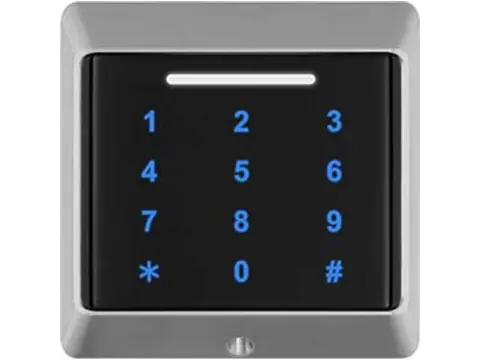
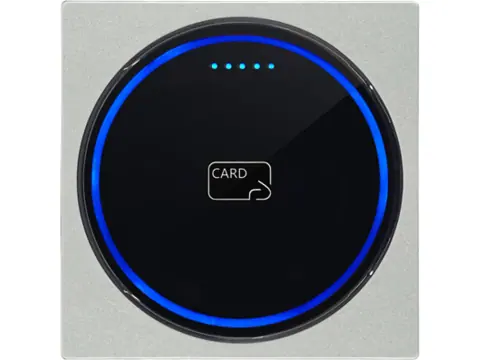
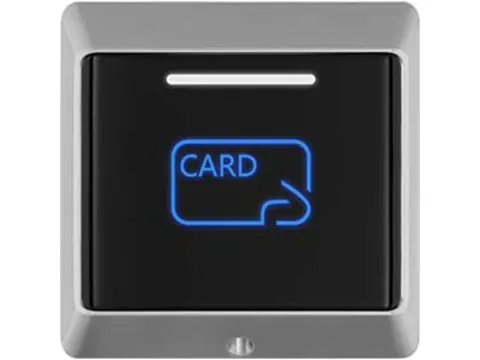
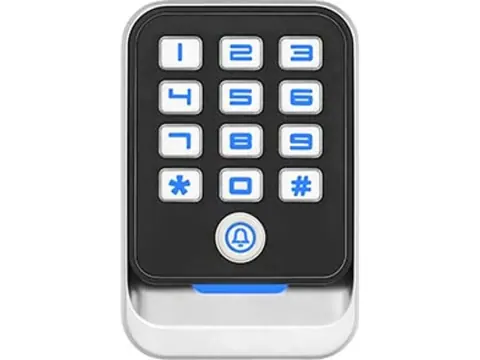
Browse our access control readers for LF, HF and dual-frequency options, and read 125 kHz vs 13.56 MHz for a credential-level comparison.
UHF wins where hands-free range and volume matter. A windshield tag reads at several meters as a car approaches a barrier, so the driver never reaches out of the window. At a dock door, a pallet of tagged cartons passes a portal in seconds and every case is counted without line of sight. Many sites combine both: UHF for vehicle lanes and asset flows, HF cards for pedestrian doors.
Can a phone read UHF tags?
No. A phone’s NFC radio operates only at 13.56 MHz and is designed for a few centimeters of range, so it cannot power or decode a UHF tag at 860–960 MHz. The same applies to 125 kHz LF cards; phones cannot read them either.
To work with UHF tags from a mobile device, you have three options:
- A rugged Android handheld with a built-in UHF reader module, which runs your app directly.
- A Bluetooth UHF reader, often called a sled, that pairs with a phone or tablet running your app.
- A USB desktop reader or writer for encoding and enrollment at a workstation.
Our handheld UHF readers follow the first approach: rugged Android terminals with integrated UHF modules. Confirm the regional band and SDK or app support for your software before ordering.
Typical applications by band
| Application | Usual band | Why |
|---|---|---|
| Door cards and key fobs | HF for new projects; LF at legacy sites | Short, deliberate range; AES-capable credentials at HF |
| Elevator and turnstile readers | HF or LF, often alongside QR | Same credentials as the doors |
| Hotel and multifamily locks | HF | Card encoding and sector security |
| Payment, transit and ID cards | HF (ISO/IEC 14443) | Secure smart-card protocols |
| Smart posters and product authentication | NFC (e.g., NTAG21x, NTAG 424 DNA) | Readable by phones |
| EV charger authorization | HF cards and fobs | Tap to start at the charger |
| Pet and livestock ID | LF 134.2 kHz (ISO 11784/11785); UHF ear tags in some herds | Tolerant of tissue and water; established animal ID standard |
| Vehicle access and parking | UHF | Hands-free reads at several meters |
| Warehouse, pallets and dock doors | UHF | Bulk reads without line of sight |
| Retail and apparel inventory | UHF | Many items counted per scan |
| Asset and tool tracking | UHF on-metal tags; HF for close-range check-in | Range plus durable tags |
| Laundry and linen | UHF or HF laundry tags | Bulk counting at UHF; single-item reads at HF |
| Container and truck seals | UHF, sometimes combined with NFC | Gate reads at range; phone checks by tap |
Choosing a reader and tag for each band
LF (125 kHz). Confirm the credential family before anything else. EM4100/TK4100-type cards and HID Prox-format credentials use different modulation and data formats, so a reader built for one does not automatically read the other. Writable T5577 and EM4305 chips can be configured to emulate some read-only formats, which is convenient for replacement cards and is also why LF cards are easy to clone. Check the output format as well, such as Wiegand 26 or 34 bits.
HF (13.56 MHz). Decide whether the reader only needs the card’s UID or must authenticate to data on the card. UID-only reading works with almost any ISO/IEC 14443A reader but offers little security. Reading MIFARE Classic sectors or DESFire applications needs a reader that supports those commands and a plan for key management. Confirm ISO/IEC 14443A, 14443B or 15693 support, and use dual-frequency readers when migrating a site from 125 kHz to 13.56 MHz.
NFC. For phone-readable tags, choose an NFC Forum type (Type 2 for simple URLs and IDs, Type 4 when you need AES-based authentication) and encode NDEF records. For phone-as-credential access, the reader and the access platform must both support the mobile credential scheme you plan to issue.
UHF (860–960 MHz). Start with the regional band, then the reader form factor: an integrated reader with a built-in antenna, a fixed multiport reader with external antennas, a handheld, a desktop writer or an embedded module. Match the tag to the surface (on-metal, windshield, laundry or label) and the interface to the system (Wiegand to a door controller, RS485, Ethernet or USB). Our UHF RFID range groups readers, antennas and modules by form factor.
Embedded and OEM designs. If you are building RFID into your own product, a reader module with a UART, USB or RS485 interface saves RF design work at every band. See our RFID reader modules for 125 kHz, 13.56 MHz and multi-technology options.
Band selection checklist
- Read distance needed: centimeters (LF, HF, NFC) or meters (UHF)?
- Deliberate tap, or hands-free and multi-tag reading?
- Security level: is a fixed ID acceptable, or is cryptographic authentication required?
- Credentials already on site, and whether phones must read the tags.
- Surface and contents: metal, liquids, tissue or textiles.
- Country of installation, and therefore the UHF band.
- Output interface: Wiegand, RS485, USB, UART or Ethernet.
- Environment: IP rating, temperature range and mounting method.
- Tag format: card, fob, label, hard tag, on-metal or embedded.
Next steps
Tell us the band you need (or the problem you are solving), the credentials or tags already on site, your controller or host interface, and the country of installation. We will confirm reader and tag compatibility, test samples before dispatch and quote the hardware. Request a quote or samples to get started.
Frequently asked questions
Is NFC the same as RFID?
NFC is a subset of HF RFID. It runs at 13.56 MHz, builds on ISO/IEC 14443, ISO/IEC 15693 and FeliCa, and adds ISO/IEC 18092 plus NFC Forum data formats, so every NFC tag is an HF RFID tag but not every RFID tag is NFC.
Can a smartphone read 125 kHz or UHF RFID tags?
No. Phone NFC radios work only at 13.56 MHz. For UHF tags, use a dedicated reader instead, such as a rugged Android handheld with a built-in UHF module or a Bluetooth UHF reader paired with the phone.
Which RFID frequency is best for access control cards?
For new projects, 13.56 MHz cards with AES-128 authentication, such as MIFARE DESFire EV2/EV3, are the usual choice. 125 kHz cards carry a fixed ID that is easy to copy, so keep them for legacy compatibility and migrate with dual-frequency readers.
What is RAIN RFID?
RAIN RFID is the industry alliance's name for passive UHF RFID that uses the GS1 EPC Gen2 air interface, standardized as ISO/IEC 18000-63. A RAIN tag and an EPC Gen2 UHF tag are the same thing.
Why does UHF RFID struggle near metal and water?
Water absorbs UHF energy and detunes tag antennas, and metal reflects the signal and cancels a standard dipole mounted flat against it. On-metal tags use the metal surface as part of their antenna design, and careful placement helps with liquids.
What RFID frequency is used for animal identification?
ISO 11784/11785 animal ID uses 134.2 kHz LF, with FDX-B and HDX transponders in ear tags, boluses and implants. Some livestock operations also use UHF ear tags where longer read range is needed.
Want a second opinion on your spec?
Send us your controller, credential type and environment — we'll recommend compatible hardware and quote within 24 hours.